Smiling person holding a clipboard and raising a fist in a gesture of determination, symbolizing motivation and perseverance, with the text “How to Stay Motivated Even When You Feel Like Giving Up (Proven Strategies That Work)” displayed across the image.

Everyone feels like giving up sometimes.

When things get hard, progress slows, or results don’t come fast enough, motivation fades. Doubt creeps in. Quitting feels easier than continuing.

But here’s the truth: Feeling like giving up is part of the process, not a sign to stop.

What separates successful people from others is not that they never struggle, it’s that they keep going anyway.

Psychologist Angela Duckworth emphasizes that persistence and grit are key factors in long-term success.

In this article, you’ll learn how to stay motivated, even when you feel like quitting.

If You Feel Like Giving Up, Watch This Video
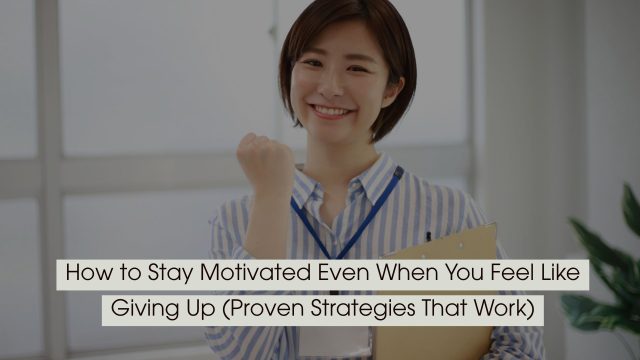
Smiling person holding a clipboard and raising a fist in a gesture of determination, symbolizing motivation and perseverance, with the text “How to Stay Motivated Even When You Feel Like Giving Up (Proven Strategies That Work)” displayed across the image.

Why You Feel Like Giving Up

Understanding the cause helps you overcome it.

1. Lack of Immediate Results

Progress takes time. When results are slow, motivation drops.

2. Mental Fatigue

Constant effort without rest can drain your energy.

3. Overwhelm

Big goals can feel intimidating.

4. Self-Doubt

Negative thoughts can reduce confidence and motivation.

The Truth About Motivation

Motivation is not constant.

Psychologist Daniel Kahneman explains that emotions and energy levels influence behavior.

This means:

  • You won’t always feel motivated
  • You can still take action without motivation

How to Stay Motivated When You Feel Like Giving Up

1. Reconnect With Your “Why”

Remind yourself why you started.

Your purpose gives meaning to your effort.

2. Focus on Small Wins

Break tasks into smaller steps.

Small achievements build momentum and confidence.

3. Take a Break, But Don’t Quit

Rest helps you recover.

Quitting stops your progress.

There’s a difference.

4. Change Your Perspective

Instead of thinking:

  • “This is too hard”

Think:

  • “This is helping me grow”

Your mindset influences your motivation.

5. Take Action Anyway

Action creates motivation.

Even small steps can rebuild momentum.

6. Remove Pressure

Perfection is not required.

Focus on progress, not perfection.

7. Surround Yourself With Support

Positive influences can boost motivation.

Engage with people who encourage growth.

The Role of Discipline

Motivation may start the journey, but discipline keeps you going.

According to Roy F. Baumeister, self-control helps maintain behavior over time.

Discipline allows you to take action even when motivation is low.

The Motivation Loop

Here’s how motivation builds: Action → Progress → Confidence → Motivation

Waiting for motivation delays progress.

Taking action creates it.

Common Mistakes to Avoid

Waiting for the Perfect Moment

There is no perfect time to act.

Comparing Yourself to Others

Focus on your own progress.

Expecting Fast Results

Growth takes time.

Giving Up Too Early

Most success comes from persistence.

How to Build Long-Term Motivation

Create a Routine

Routines reduce reliance on motivation.

Track Progress

Seeing results increases motivation.

Celebrate Small Wins

Recognizing progress reinforces effort.

Stay Consistent

Consistency builds momentum.

When You Feel Like Giving Up, Remember This

  • You’ve made progress
  • Challenges are part of growth
  • Quitting stops your potential

Sometimes, success is just one more step beyond where you feel like stopping.

Conclusion

Feeling like giving up is normal.

But it doesn’t have to define your outcome.

By focusing on your purpose, taking small actions, and building discipline, you can stay motivated even during difficult times.

Personal development is not about always feeling inspired, it’s about continuing despite challenges.

Keep going.

Because the moment you feel like quitting might be the moment you’re closest to a breakthrough.

Sources and Further Reading

  • Angela Duckworth – Grit and persistence
  • Daniel Kahneman – Decision-making psychology
  • Roy F. Baumeister – Self-control research
  • Duckworth, A. (2016). Grit

About the Author

David A. Caren is the creator of Emotional Optimization – helping high-performing professionals rewire emotional patterns for clarity, calm, and success.

Book a Free Consultation

How do I stay motivated when I feel like quitting?

Focus on small steps, reconnect with your purpose, and take action.

Is it normal to lose motivation?

Yes. Motivation naturally fluctuates.

Can discipline replace motivation?

Yes. Discipline ensures consistency.

How do I rebuild motivation?

Start with small actions and build momentum.

Should I take breaks?

Yes. Rest is important, but don’t quit.
Tap Into Your Emotional Superpowers:

Reclaim Your Mental & Emotional Resources To Do More, Be More, & LIVE More Fully

The Desire: Reclaim Your Joy, Purpose & Inner Peace with Emotional Optimization

In the hustle and bustle of today's world, do you feel like your emotions are on a rollercoaster with no brakes? Caught in a relentless storm of stress, anxiety, and uncertainty; it's all too easy to feel lost, disconnected from your true self, and powerless in steering the course of your own life.

In the bustling rhythm of modern life, where achievements are often measured in milestones and material success, it's easy to overlook the silent whispers of our inner selves. Like a ship navigating a vast, unpredictable ocean, we often find ourselves lost in the storms of overwhelm, stress, anxiety, and unfulfilled desires. This is the journey of every single soul searching for a ray of light in the darkness - a calm, peaceful, fulfilled life with emotional serenity, inner confidence and strength. Emotional Optimization is a way to navigate your inner world, to release the energy you've been wasting on old triggers and buttons, and to reclaim your mental and emotional resources so you can do more in life, create a bigger impact on the world, and live life more fully on your terms as you continue your journey to emotional mastery.

The Challenge: Emotional Triggers & Unresolved Traumas

Pause for a moment and imagine the heavy toll those unchecked emotions are having on your life. Relationships strained to their breaking points, opportunities slipping like sand through your fingers, and a constant, gnawing sense of not living up to your full potential. This isn't just about facing daily hurdles; it's about the very essence of your happiness and fulfillment being eroded away, day after draining day, WASTING your precious life REACTING to unresolved emotional triggers and old traumas.

Imagine walking through a labyrinth, where each turn represents a challenge, a moment of doubt, or a trigger of unresolved emotion. This is the odyssey of the modern high achiever. Despite the outward success, there always seems to be an underlying struggle - a battle with emotions that feel like uncharted waters. In an age where the pursuit of happiness often leads to more questions than answers, many find themselves adrift, caught in a cycle of emotional highs and lows, constantly looking for a safe place where they can achieve balance, peace, and genuine fulfillment.


The Solution: Emotional Optimization

This is where Emotional Optimization comes in. David's highly personalized coaching program is designed to equip you with the tools and strategies you need to understand, manage, and transform your emotions. By mastering emotional intelligence, you unlock the door to improved communication, stronger relationships, and heightened self-awareness. It's time to reclaim all the mental and emotional resources you've been wasting in the background on the subconscious emotional triggers from past traumas and unresolved emotions. You deserve to live FREE from the emotional baggage and burdens of your past. It's time to step into peace, confidence, and clarity, so you can be more present, have deeper relationships, and feel more fulfilled in life.

Benefits:

  • Enhanced Emotional Intelligence: Elevate your ability to understand, process, use, & manage your emotions in positive ways to relieve stress, communicate effectively, empathize with others, overcome challenges, & make choices that align with your deepest values & aspirations.
  • Improved Relationships: Transform your personal and professional relationships through self-reflection, better communication, empathy, and emotional understanding.
  • Increased Emotional Resilience: Build a robust emotional foundation that enables you to navigate life's ups & downs with grace & poise, turning potential setbacks into opportunities for growth. Arm yourself with resilience that turns life's fiercest storms into moments of strength & empowerment.
  • Personal and Professional Growth: Unlock your full potential by harnessing the power of emotional optimization to achieve your goals, boost productivity, and amplify a sense of accomplishment, satisfaction, and fulfillment in all areas of life.

About The Author

David's Team

Let's Connect!

Leave a comment

Your email address will not be published. Required fields are marked

{"email":"Email address invalid","url":"Website address invalid","required":"Required field missing"}
Group of people sitting in a support circle, offering comfort and encouragement to one person, symbolizing resilience and emotional strength, with the text “Mental Toughness: How to Build Resilience in Tough Times (Proven Strategies to Stay Strong)” displayed across the image.

Mental Toughness: How to Build Resilience in Tough Times (Proven Strategies to Stay Strong)

Mental toughness is the ability to stay strong and resilient during difficult times. By building discipline, managing thoughts, and taking consistent action, individuals can overcome challenges and achieve long-term success.

Read More
Group of people practicing yoga in a studio, focusing on breathing and posture, symbolizing mental discipline and focus, with the text “How to Train Your Brain for Discipline and Focus (Science-Backed Strategies That Work)” displayed across the image.

How to Train Your Brain for Discipline and Focus (Science-Backed Strategies That Work)

Training your brain for discipline and focus requires consistent practice, strong habits, and the right environment. By building routines and reducing distractions, you can improve concentration and achieve long-term success.

Read More
Person jogging outdoors along a path beside a stone wall and greenery, representing steady progress and daily consistency, with the text “The Power of Consistency: Why Small Actions Matter More Than Big Efforts” displayed across the image.

The Power of Consistency: Why Small Actions Matter More Than Big Efforts

Consistency is the key to long-term success. Small actions repeated daily may seem insignificant, but over time, they create powerful results that shape personal development and achievement.

Read More
Close-up of a person gripping a barbell in a gym, symbolizing strength, discipline, and consistency, with the text “Why Discipline Beats Motivation Every Time (The Real Key to Long-Term Success)” displayed across the image.

Why Discipline Beats Motivation Every Time (The Real Key to Long-Term Success)

Discipline beats motivation because it creates consistency. While motivation fades, discipline ensures daily action, helping individuals build habits, stay productive, and achieve long-term success.

Read More
Person holding a book up to their face while reading, symbolizing learning and self-improvement, with the text “Atomic Habits Explained: Small Changes That Lead to Big Results (A Complete Guide to Lasting Change)” displayed across the image.

Atomic Habits Explained: Small Changes That Lead to Big Results (A Complete Guide to Lasting Change)

Atomic Habits shows that small, consistent actions can lead to significant long-term results. By focusing on simple habits and applying proven strategies, individuals can achieve lasting personal development and success.

Read More
Person lifting dumbbells in a gym with guidance from a trainer, representing discipline, consistency, and effort, with the text “Self-Discipline Mastery: How to Stay Consistent Every Day (Proven Strategies for Long-Term Success)” displayed across the image.

Self-Discipline Mastery: How to Stay Consistent Every Day (Proven Strategies for Long-Term Success)

Self-discipline mastery is about consistency, not motivation. By building systems, removing distractions, and taking daily action, you can stay consistent and achieve long-term personal development success.

Read More