Table of Contents
- What Does It Mean to Waste Your Potential?
- Why Potential Can Become a Trap
- 1. Stop Waiting to Discover Your “True Potential”
- 2. Identify Where You’re Underperforming
- 3. Calculate the Cost of Staying the Same
- 4. Stop Mistaking Preparation for Progress
- 5. Choose a Skill With Compounding Value
- 6. Replace Passive Consumption With Active Creation
- 7. Put Yourself in Situations That Demand Growth
- 8. Finish More Things
- 9. Stop Protecting Your Ego
- 10. Measure Evidence, Not Intentions
- 11. Build a Life That Requires the Best of You
- The Potential-to-Performance Gap
- The One-Year Question
- Create Your Personal Growth Project
- Stop Trying to Prove You’re Talented
- Signs You May Be Wasting Your Potential
- A 30-Day Stop Wasting Your Potential Challenge
- What Reaching Your Potential Really Looks Like
- Common Mistakes When Trying to Reach Your Potential
- How to Know If You’re Moving in the Right Direction
- The Potential Formula
- Conclusion
- Sources and Further Reading
One of the most frustrating feelings in personal development is knowing you’re capable of more but not seeing that potential reflected in your life.
You have ideas you haven’t acted on.
Skills you haven’t developed.
Goals you’ve repeatedly postponed.
Opportunities you’ve considered but never pursued.
You may even look at your current situation and think:
“I know I can do more than this.”
But potential alone doesn’t create results.
Potential is possibility.
What eventually matters is what you develop, practice, build, and contribute.
The good news is that feeling underutilized doesn’t mean you’ve permanently wasted your abilities. It may simply mean there is a gap between what you’re capable of becoming and what your current behaviors are producing.
That gap can change.
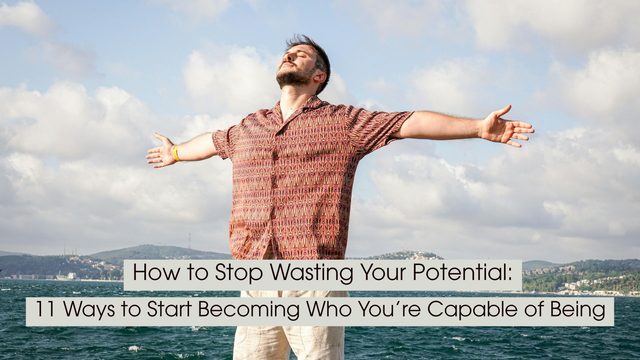
This article explores why people fail to use their potential and 11 practical ways to turn ability into meaningful progress.
What Does It Mean to Waste Your Potential?
“Wasting your potential” doesn’t mean you must become famous, wealthy, exceptionally productive, or better than everyone around you.
It simply means that your current choices aren’t fully developing or using abilities that matter to you.
For example, you might:
- Have a valuable skill you rarely practice.
- Want a better career but never apply for opportunities.
- Have business ideas but never test them.
- Want to become healthier but continually postpone action.
- Know you need additional education but keep delaying it.
- Have creative ambitions that remain unfinished.
- Spend most of your free time consuming instead of creating.
The issue isn’t that you must maximize every ability.
Nobody can.
The issue is repeatedly neglecting something that you genuinely believe matters.
Why Potential Can Become a Trap
Being told that you “have potential” sounds positive.
But potential can become psychologically comfortable.
It allows you to imagine what you could accomplish without facing the uncertainty of discovering what you actually can accomplish.
As long as you don’t seriously try, you can continue believing:
“I could probably do it if I really wanted to.”
Real effort introduces risk.
You might fail.
You might discover you’re not naturally exceptional.
You might need years of practice.
You might succeed and suddenly face greater responsibility.
That’s why developing your potential requires something imagination doesn’t:
exposure to reality.
You have to act.
1. Stop Waiting to Discover Your “True Potential”
There probably isn’t one predetermined version of your life waiting to be discovered.
Your capabilities develop through experience.
You become better at things by:
- Learning
- Practicing
- Experimenting
- Receiving feedback
- Solving problems
- Making mistakes
- Trying again
Instead of asking:
“What’s my full potential?”
Ask:
“What could I become significantly better at over the next few years?”
That’s a question you can actually work with.
2. Identify Where You’re Underperforming
Take an honest look at your life.
Which area bothers you because you know your current results don’t reflect your capabilities?
It might be:
Career
You’re capable of greater responsibility but remain passive.
Health
You understand what would help but rarely follow through.
Finances
Your income has increased, but your financial habits haven’t matured.
Education
You want to develop valuable skills but spend little time learning.
Creativity
You constantly generate ideas but rarely finish anything.
Relationships
You care about people but don’t consistently invest time in important relationships.
Choose one area.
Specific dissatisfaction is more useful than vaguely believing you should be “doing more.”
3. Calculate the Cost of Staying the Same
People usually think about what change will cost.
Learning a new skill requires time.
Starting a business involves uncertainty.
Improving your health requires effort.
Changing careers can be uncomfortable.
But staying where you are also has a cost.
Ask:
“If nothing changes for the next five years, where will this path take me?”
Imagine your:
- Career
- Health
- Finances
- Skills
- Relationships
- Confidence
- Lifestyle
Sometimes the cost of inaction becomes clearer when you extend today’s behavior into the future.
4. Stop Mistaking Preparation for Progress
Preparation matters.
But preparation can also become sophisticated procrastination.
You research.
Watch tutorials.
Read books.
Build plans.
Buy equipment.
Take courses.
Create spreadsheets.
Yet you never enter the situation where your abilities are actually tested.
At some point, learning must become application.
If you’re learning writing, publish something.
If you’re learning coding, build something.
If you’re studying business, test an offer.
If you’re learning public speaking, speak in front of people.
Knowledge becomes more valuable when it survives contact with reality.
5. Choose a Skill With Compounding Value
You don’t need to become good at everything.
Develop abilities that create opportunities across multiple areas.
Depending on your goals, valuable skills might include:
- Communication
- Writing
- Leadership
- Sales
- Negotiation
- Data analysis
- Programming
- Financial literacy
- Public speaking
- Marketing
- Project management
- Problem-solving
Ask:
“Which skill would create the greatest number of new opportunities for me?”
Then give that skill sustained attention.
An hour spent developing a useful ability can continue paying dividends years later.
6. Replace Passive Consumption With Active Creation
Modern life makes consumption extremely easy.
You can spend hours:
- Watching videos
- Scrolling social media
- Reading discussions
- Listening to podcasts
- Following other people’s lives
- Consuming entertainment
None of these activities are automatically harmful.
The problem appears when consumption occupies nearly all the time that could have been used to create something meaningful.
Try changing the ratio.
Instead of:
Three hours consuming + zero minutes creating
move toward:
Two hours consuming + one hour creating
Create:
- An article
- A project
- A portfolio
- A business offer
- A presentation
- A design
- A piece of software
- A training plan
- A useful resource
Consumption gives you information.
Creation reveals what you can actually do.
7. Put Yourself in Situations That Demand Growth
Your environment influences what develops.
If your current life never requires you to stretch your abilities, growth can become optional.
Look for challenges slightly beyond your current competence.
That might mean:
- Taking responsibility for a difficult project
- Applying for a more demanding role
- Entering a competition
- Presenting your work publicly
- Leading a team
- Working with more experienced people
- Accepting constructive feedback
- Taking a course with real assessments
The objective isn’t constant discomfort.
It’s avoiding permanent comfort.
Growth often accelerates when your environment requires you to improve.
8. Finish More Things
Unfinished projects create the illusion of progress.
You started the course.
You drafted the business idea.
You created the outline.
You bought the equipment.
You wrote three chapters.
But unfinished work produces limited feedback.
Completion teaches you things that starting cannot.
Finishing forces you to:
- Solve unexpected problems
- Make decisions
- Accept imperfections
- Meet standards
- Receive feedback
- Produce an actual result
Create a rule:
Finish something before starting another major project.
You don’t have to finish everything you’ve ever begun.
Some projects deserve abandonment.
But intentional completion should become a skill.
9. Stop Protecting Your Ego
Potential can remain perfect when it’s never tested.
Actual performance cannot.
Once you try, people may judge your work.
You might discover weaknesses.
Someone may outperform you.
Your first attempt might be embarrassing.
This is where many people retreat.
They’d rather appear talented than temporarily look inexperienced.
But becoming good at something usually requires being willing to look average at it first.
Ask:
“Would I rather protect the image of being talented or develop actual competence?”
The second option requires more humility.
It also creates more growth.
10. Measure Evidence, Not Intentions
Your intentions tell you what you care about.
Your behavior tells you what you’re currently building.
Instead of saying:
“I’m serious about improving my career.”
Measure:
- Applications submitted
- Skills practiced
- Projects completed
- Professional conversations initiated
Instead of:
“I’m serious about getting fit.”
Measure:
- Workouts completed
- Steps taken
- Training sessions attended
Instead of:
“I’m going to start writing.”
Measure:
- Articles completed
- Pages written
- Publishing frequency
Turn vague ambition into observable evidence.
11. Build a Life That Requires the Best of You
The ultimate goal isn’t to become obsessed with productivity.
It’s to build a life where your abilities have somewhere meaningful to go.
That may involve:
- Work that challenges you
- Relationships that encourage growth
- Responsibilities that matter
- Projects you care about
- Skills worth developing
- Problems worth solving
Potential becomes meaningful when it has a purpose.
You don’t need to maximize every hour.
You need something worth giving your effort to.
The Potential-to-Performance Gap
Think about personal growth using this simple framework:
Potential → Practice → Competence → Performance → Feedback → Growth
Potential alone is only the beginning.
Potential
You may be capable of learning something.
Practice
You repeatedly develop the ability.
Competence
Your skill improves.
Performance
You use the skill in real situations.
Feedback
Reality shows you what’s working.
Growth
You adjust and improve.
Then the cycle repeats.
The missing step for many people isn’t potential.
It’s consistent exposure to practice and feedback.
The One-Year Question
Ask yourself:
“If I spent the next 12 months seriously developing one part of myself, which area could change my life the most?”
Don’t choose ten.
Choose one.
Maybe it’s:
- Becoming physically stronger
- Building a professional skill
- Improving communication
- Starting a business
- Becoming financially organized
- Completing your education
- Building a portfolio
- Developing leadership ability
Then imagine what one year of consistent improvement could produce.
Not one year of perfection.
One year of direction.
Create Your Personal Growth Project
Instead of vaguely trying to “improve yourself,” create a project.
For example:
Goal
Become a competent public speaker.
Duration
Six months.
Actions
- Study presentation fundamentals.
- Give one presentation each month.
- Record yourself speaking.
- Request feedback.
- Practice difficult sections.
- Review progress monthly.
Now personal development has structure.
You can do the same for almost any skill.
Stop Trying to Prove You’re Talented
Talent is attractive because it makes achievement look effortless.
But effort isn’t evidence that you’re incapable.
Struggling while learning something difficult is normal.
If another person learns faster than you, that doesn’t automatically mean you should quit.
The more useful questions are:
“Am I improving?”
“Is this worth developing?”
“What would deliberate practice look like?”
Your goal isn’t to prove that success comes naturally.
Your goal is to become capable.
Signs You May Be Wasting Your Potential
You might need to reassess your direction if:
- You constantly talk about goals but rarely work on them.
- You consume significantly more than you create.
- You repeatedly avoid situations where your abilities would be tested.
- You have dozens of unfinished projects.
- You spend more time planning than practicing.
- You remain in comfortable situations you’ve clearly outgrown.
- You know which skill you need but keep postponing learning it.
- You regularly feel disappointed by how little you’re using your abilities.
These aren’t reasons to attack yourself.
They’re signals.
Use them to identify what needs to change.
A 30-Day Stop Wasting Your Potential Challenge
Use the next month to move from intention to evidence.
Week 1: Choose
Identify one area where you believe you’re underperforming.
Choose one measurable improvement.
Week 2: Practice
Spend dedicated time developing the skill or behavior.
Keep the sessions realistic enough to repeat.
Week 3: Produce
Create something that demonstrates your ability.
Don’t keep everything private.
Finish a real output.
Week 4: Test
Get feedback.
Publish.
Present.
Apply.
Compete.
Measure.
Allow reality to show you what needs improvement.
At the end of 30 days, ask:
“What can I do now that I couldn’t do as well one month ago?”
That’s growth.
What Reaching Your Potential Really Looks Like
Reaching your potential isn’t a final destination.
There is no morning when you wake up and receive confirmation that you’ve officially maximized yourself.
Your abilities change.
Your interests evolve.
New opportunities appear.
Your priorities shift.
That’s why a healthier goal is:
Continue developing your ability to learn, adapt, contribute, and pursue meaningful challenges.
Your potential isn’t something you eventually finish.
It’s something you continue exploring.
Common Mistakes When Trying to Reach Your Potential
Trying to Optimize Everything
You cannot maximize every part of your life simultaneously.
Choose priorities.
Comparing Your Potential With Someone Else’s Results
You rarely know another person’s full circumstances, experience, advantages, or sacrifices.
Focus on your development.
Chasing Every Opportunity
Potential isn’t developed by saying yes to everything.
Focus creates depth.
Believing You Need Constant Motivation
Some development will be exciting.
Some will be repetitive.
Both matter.
Expecting Fast Results
Competence often takes longer than enthusiasm expects.
Give meaningful goals enough time.
Treating Rest as Wasted Time
Recovery supports sustainable performance.
The objective isn’t nonstop output.
It’s effective development.
How to Know If You’re Moving in the Right Direction
Ask yourself every few months:
- What have I learned?
- What can I do better than before?
- What have I completed?
- What difficult situations have I faced?
- What feedback have I received?
- What opportunities have my new abilities created?
- What should I develop next?
If your answers continue changing, you’re probably not standing still.
The Potential Formula
A useful way to think about development is:
Ability + Deliberate Practice + Real-World Application + Feedback + Time = Growth
You can’t completely control your natural abilities or every opportunity available to you.
But you can influence how seriously you develop what you have.
Conclusion
The fear of wasting your potential can either become another source of pressure or a reason to start taking meaningful action.
Choose the second.
You don’t need to become extraordinary at everything.
You don’t need to achieve someone else’s definition of success.
And you don’t need to transform your entire life this month.
Choose something that matters.
Develop the skills it requires.
Finish real work.
Test yourself.
Accept feedback.
Improve.
Then continue.
Your potential isn’t proven by imagining everything you could become. It’s revealed by what you’re willing to practice, build, finish, and improve.
Sources and Further Reading
- Carol Dweck. Mindset: The New Psychology of Success (2006)
- Anders Ericsson and Robert Pool. Peak: Secrets from the New Science of Expertise (2016)
- Angela Duckworth. Grit: The Power of Passion and Perseverance (2016)
- Albert Bandura. Research on self-efficacy and human agency
- Cal Newport. So Good They Can’t Ignore You (2012)
- Mihaly Csikszentmihalyi. Flow: The Psychology of Optimal Experience (1990)
- Adam Grant. Hidden Potential: The Science of Achieving Greater Things (2023)
About the Author
David A. Caren is the creator of Emotional Optimization™ – helping high-performing professionals rewire emotional patterns for clarity, calm, and success.
Book a Free Consultation
How do I know if I’m wasting my potential?
You may feel you’re wasting your potential when there’s a persistent gap between abilities or goals you genuinely value and the effort you’re making to develop or pursue them.
How can I stop wasting my potential?
Choose one meaningful area for improvement, identify the skills or behaviors it requires, practice consistently, complete real projects, and seek feedback.
Why am I afraid to reach my full potential?
Fear of failure, judgment, uncertainty, responsibility, or discovering your current limitations can make meaningful challenges uncomfortable. Taking smaller real-world actions can make those fears easier to evaluate.
How do I unlock my full potential?
There is no single method or fixed definition of “full potential.” Focus on continually developing useful skills, seeking meaningful challenges, applying what you learn, and adapting based on feedback.
Is procrastination a sign of wasted potential?
Procrastination can prevent you from developing important abilities, but it can have many causes. Instead of labeling yourself, identify what you’re avoiding and why.

What Highly Successful People Do Differently (Proven Habits That Set Them Apart)
Highly successful people stand out through their habits, mindset, and consistency. By focusing on high-impact actions, embracing failure, and committing…


The Secret Power of Emotional Intelligence: Why It Matters More Than IQ for Success
Emotional intelligence is the ability to understand and manage emotions, making it a powerful driver of success. By improving self-awareness,…
How to Build Self-Trust and Start Believing in Yourself Again: 12 Practical Strategies
Have you ever promised yourself you would change something, only to find yourself repeating the same behavior? Maybe you planned to…
How to Stop Wasting Your Potential: 11 Ways to Start Becoming Who You’re Capable of Being
Potential: Knowing you’re capable of more can be frustrating when your actions don’t reflect your ambitions. Learn how to stop…

How to Get Your Life Together When You Feel Stuck: A Practical Step-by-Step Guide
Get your life together: Feeling stuck doesn’t mean you need to completely rebuild your life overnight. Learn how to get…

Digital Overload and Burnout: How Technology Is Fueling Modern Exhaustion
Digital overload is becoming a major contributor to burnout in modern life. Constant notifications, information overload, and excessive screen time…