Table of Contents
- What Is Imposter Syndrome?
- What Is Anxiety?
- Why Imposter Syndrome and Anxiety Often Come Together
- How Imposter Syndrome Triggers Anxiety
- How Anxiety Strengthens Imposter Syndrome
- The Self-Reinforcing Cycle: How They Feed Each Other
- Common Signs You’re Stuck in the Imposter-Anxiety Loop
- Why High Achievers Are More Vulnerable
- The Hidden Belief Behind Both: “I Am Not Safe Unless I Perform Perfectly”
- How to Break the Cycle (Step-by-Step)
- 1. Name the Pattern Instead of Becoming It
- 2. Stop Using Anxiety as Evidence You’re Not Good Enough
- 3. Replace “Prove Yourself” With “Practice”
- 4. Use the 80% Rule to Reduce Perfectionism
- 5. Create a “Reality File” of Your Achievements
- 6. Learn to Self-Soothe Your Nervous System
- 7. Practice “Imperfect Visibility”
- 8. Stop Comparing Your Inside to Other People’s Outside
- 9. Talk to Someone (Yes, Really)
- 10. Redefine Confidence
- When to Seek Professional Support
- Final Thoughts: You’re Not an Imposter, You’re Growing
- Sources & Further Reading
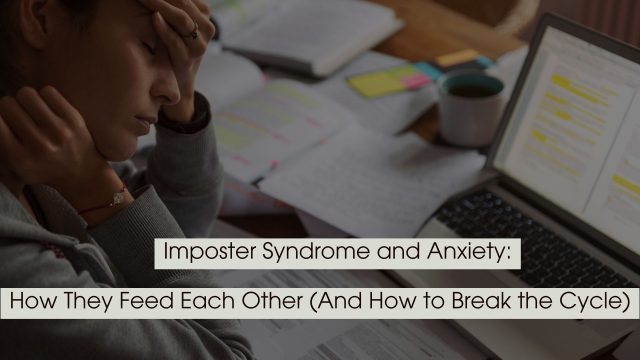
Imposter syndrome and anxiety are two of the most common internal struggles people face, especially high achievers, perfectionists, and anyone stepping into a new role or level of responsibility. And while they’re often discussed separately, the truth is they frequently show up together, creating a cycle that can feel exhausting and impossible to escape.
If you’ve ever thought:
- “What if they realize I’m not good enough?”
- “I don’t deserve to be here.”
- “I need to work harder so no one notices I’m struggling.”
…you may be experiencing the powerful connection between imposter syndrome and anxiety.
In this article, we’ll explore how these two feed each other, why the cycle feels so strong, and what you can do to regain control, confidence, and emotional peace.
What Is Imposter Syndrome?
Imposter syndrome is the belief that your success is not real, or not deserved.
Even when you have proof of your skills, experience, and accomplishments, you may still feel like:
- You got lucky
- You fooled people into believing you’re competent
- You’re one mistake away from being exposed
Imposter syndrome isn’t a clinical diagnosis, but it’s a very real experience that affects how people think, feel, and perform.
What Is Anxiety?
Anxiety is your mind and body’s response to perceived danger, even if no real danger exists.
It often shows up as:
- Constant worry
- Overthinking
- Racing thoughts
- Physical tension
- Restlessness
- Fear of failure or judgment
Anxiety is designed to protect you, but when it becomes constant, it can reduce your ability to focus, perform, and feel calm.
Why Imposter Syndrome and Anxiety Often Come Together
Imposter syndrome is rooted in fear.
Anxiety is fueled by fear.
So when you experience imposter syndrome, it naturally activates anxiety, because your brain interprets the situation as threatening.
The “threat” isn’t physical. It’s emotional:
- Fear of embarrassment
- Fear of rejection
- Fear of failing publicly
- Fear of losing respect
- Fear of not being enough
This is why the two often feel inseparable.
How Imposter Syndrome Triggers Anxiety
When you believe you’re not truly capable, your brain becomes hyper-alert.
You start anticipating danger in everyday situations like:
- Speaking in meetings
- Presenting ideas
- Posting content online
- Applying for a promotion
- Starting a new job
- Trying a new skill
Your nervous system responds as if something terrible is about to happen.
That’s anxiety.
How Anxiety Strengthens Imposter Syndrome
Here’s where the cycle becomes intense:
When anxiety rises, you begin to doubt yourself even more.
Anxiety creates symptoms like:
- Brain fog
- Forgetfulness
- Lack of confidence
- Shaky voice
- Difficulty focusing
- Avoidance
And then your mind says: “See? You’re struggling. You’re not good enough.”
So anxiety becomes “proof” of being an imposter, even though anxiety is actually a normal stress response.
The Self-Reinforcing Cycle: How They Feed Each Other
This is what the loop often looks like:
- You succeed or step into something new
- Imposter thoughts appear
- You fear being exposed
- Anxiety increases
- You overwork or overthink
- You become exhausted
- You make small mistakes
- You interpret mistakes as failure
- Imposter syndrome intensifies
- Anxiety rises again
This cycle can repeat for months, or even years, unless you consciously interrupt it.
Common Signs You’re Stuck in the Imposter-Anxiety Loop
If you’re not sure whether you’re experiencing both, here are common signs:
Emotional Signs
- Feeling constantly on edge
- Fear of judgment
- Shame after small mistakes
- Feeling undeserving of success
Mental Signs
- Overthinking everything you say
- Comparing yourself constantly
- Believing others are more qualified
- Catastrophic thinking (“If I mess up, everything is ruined”)
Behavioral Signs
- Avoiding opportunities
- Procrastination
- Over-preparing
- People-pleasing
- Working late to “prove yourself”
Physical Signs
- Tension headaches
- Tight chest
- Upset stomach
- Fatigue
- Trouble sleeping
Why High Achievers Are More Vulnerable
Ironically, the more capable you are, the more likely you are to experience imposter syndrome and anxiety.
Why?
Because high achievers often:
- Set extremely high standards
- Fear disappointing others
- Attach identity to performance
- Feel pressure to maintain success
- Struggle to rest without guilt
When you’re constantly trying to “earn” your worth, anxiety becomes your default state.
The Hidden Belief Behind Both: “I Am Not Safe Unless I Perform Perfectly”
This belief often sits beneath both struggles.
It may not sound dramatic, but your nervous system treats it like a life-or-death rule: “If I fail, I will be rejected.”
Even if rejection isn’t actually happening, your body still responds as if it is.
How to Break the Cycle (Step-by-Step)
The good news: you can break the imposter-anxiety loop.
But you don’t break it by forcing confidence.
You break it by building emotional safety and self-trust.
Here are practical steps.
1. Name the Pattern Instead of Becoming It
When you feel anxious, pause and say: “This is imposter syndrome activating anxiety.”
Naming it creates distance.
It reminds you:
- You are not broken
- You are not weak
- Your mind is reacting to fear, not truth
This simple awareness reduces emotional intensity.
2. Stop Using Anxiety as Evidence You’re Not Good Enough
One of the most important mindset shifts is this:
Feeling anxious does not mean you’re incompetent.
It means:
- You care
- You’re stretching
- You’re learning
- You’re human
Many highly skilled people feel anxious before big moments. They just don’t talk about it.
3. Replace “Prove Yourself” With “Practice”
Imposter syndrome creates pressure.
Pressure creates anxiety.
Instead of thinking: “I have to prove I belong here.”
Shift to: “I’m allowed to practice and improve.”
This instantly lowers your nervous system response.
4. Use the 80% Rule to Reduce Perfectionism
Perfectionism is fuel for both anxiety and imposter syndrome.
Try this:
- Aim for 80% quality
- Submit it
- Improve later
Most success comes from consistency, not perfection.
5. Create a “Reality File” of Your Achievements
When anxiety and imposter syndrome rise, your brain forgets facts.
A reality file helps you stay grounded.
Include:
- Positive feedback messages
- Results you achieved
- Projects you completed
- Compliments from clients or bosses
- Screenshots of wins
When doubt hits, read it.
This is not arrogance, it’s emotional evidence.
6. Learn to Self-Soothe Your Nervous System
If you don’t calm your body, your mind will stay stuck in fear.
Simple calming tools include:
- Deep breathing (inhale 4 seconds, exhale 6 seconds)
- Grounding (5 things you see, 4 things you feel, etc.)
- Stretching shoulders and jaw
- Walking outside for 5 minutes
Your confidence improves when your nervous system feels safe.
7. Practice “Imperfect Visibility”
One of the biggest fears in imposter syndrome is being seen.
So instead of hiding until you feel ready, try:
- Showing up even when nervous
- Speaking even if your voice shakes
- Posting even if you feel unsure
Each time you do, your brain learns: “I can be seen and still be safe.”
That is how real confidence is built.
8. Stop Comparing Your Inside to Other People’s Outside
Comparison is a major anxiety trigger.
Because you compare:
- Your fears
- Your uncertainty
- Your flaws
…to someone else’s highlight reel.
A better comparison is: “Am I improving compared to who I was last month?”
That’s real growth.
9. Talk to Someone (Yes, Really)
Imposter syndrome grows in silence.
When you talk about it, you realize:
- You’re not alone
- Many people feel the same
- Your fear is not a personal failure
Talking to a trusted friend, mentor, coach, or therapist can make a huge difference.
10. Redefine Confidence
Confidence isn’t:
- never feeling nervous
- never doubting yourself
- always being sure
Confidence is: “I can handle discomfort and keep going anyway.”
That definition makes it achievable.
When to Seek Professional Support
Sometimes imposter syndrome and anxiety become overwhelming.
Consider professional support if you experience:
- panic attacks
- chronic insomnia
- constant dread
- inability to function at work
- severe avoidance
- intense self-hatred
Therapy can help you untangle deeper beliefs and build long-term emotional safety.
Final Thoughts: You’re Not an Imposter, You’re Growing
Imposter syndrome and anxiety feed each other because they’re both rooted in fear.
But fear doesn’t mean you’re failing.
It means you’re stepping into something that matters.
The goal isn’t to eliminate fear completely.
The goal is to stop letting fear control your decisions.
With awareness, emotional regulation, and small consistent actions, you can break the cycle, and start experiencing success without constantly feeling like you don’t deserve it.
Sources & Further Reading
- Clance, P. R., & Imes, S. A. (1978). The Impostor Phenomenon in High Achieving Women: Dynamics and Therapeutic Intervention. Psychotherapy: Theory, Research & Practice.
- American Psychological Association (APA). Anxiety and Stress resources
- International Journal of Behavioral Science (2008). The Impostor Phenomenon: An Internal Barrier to Empowerment and Achievement
- Neff, K. (2011). Self-Compassion: The Proven Power of Being Kind to Yourself
- Brown, B. (2012). Daring Greatly
- Mind (UK). Anxiety and coping strategies
About the Author
David A. Caren is the creator of Emotional Optimization™ – helping high-performing professionals rewire emotional patterns for clarity, calm, and success.
Book a Free Consultation
Can imposter syndrome cause anxiety?
Yes. Imposter syndrome creates fear of being exposed or failing, which can trigger anxious thoughts and physical stress responses.
Can anxiety make imposter syndrome worse?
Absolutely. Anxiety can reduce focus and confidence, which makes you interpret normal stress symptoms as proof you’re not capable.
Why do I feel imposter syndrome even when I’m successful?
Because imposter syndrome isn’t based on evidence—it’s based on internal beliefs, perfectionism, and fear of judgment.
Is imposter syndrome a mental illness?
No. It’s not a clinical diagnosis, but it can be emotionally distressing and is often linked with anxiety and stress.
What is the fastest way to calm imposter syndrome anxiety?
The fastest approach is to calm your nervous system first (breathing, grounding, movement), then challenge the thoughts with facts.
Mental Toughness: How to Build Resilience in Tough Times (Proven Strategies to Stay Strong)
Mental toughness is the ability to stay strong and resilient during difficult times. By building discipline, managing thoughts, and taking…

How to Stay Motivated Even When You Feel Like Giving Up (Proven Strategies That Work)
Staying motivated when you feel like giving up requires persistence, small actions, and a strong mindset. By focusing on progress…
How to Train Your Brain for Discipline and Focus (Science-Backed Strategies That Work)
Training your brain for discipline and focus requires consistent practice, strong habits, and the right environment. By building routines and…
The Power of Consistency: Why Small Actions Matter More Than Big Efforts
Consistency is the key to long-term success. Small actions repeated daily may seem insignificant, but over time, they create powerful…
Why Discipline Beats Motivation Every Time (The Real Key to Long-Term Success)
Discipline beats motivation because it creates consistency. While motivation fades, discipline ensures daily action, helping individuals build habits, stay productive,…
Atomic Habits Explained: Small Changes That Lead to Big Results (A Complete Guide to Lasting Change)
Atomic Habits shows that small, consistent actions can lead to significant long-term results. By focusing on simple habits and applying…