
Table of Contents
- What is Overthinking and How to prevent it
- What Is Overthinking?
- Why Overthinking Is Holding You Back
- The Psychology Behind Overthinking
- The Science: Why Action Reduces Anxiety
- How to Stop Overthinking (Practical Strategies)
- The Long-Term Impact of Stopping Overthinking
- Signs You’re Recovering From Overthinking
- Sources & Further Reading
Personal development is often about taking action, starting the project, having the conversation, launching the idea. But overthinking quietly stops progress before it even begins.
You replay conversations.
You imagine worst-case scenarios.
You analyze every possible outcome.
And while you’re thinking… life moves on.
If you’ve ever felt stuck in your own head, this guide will show you why overthinking is holding you back, and exactly how to stop.
What is Overthinking and How to prevent it
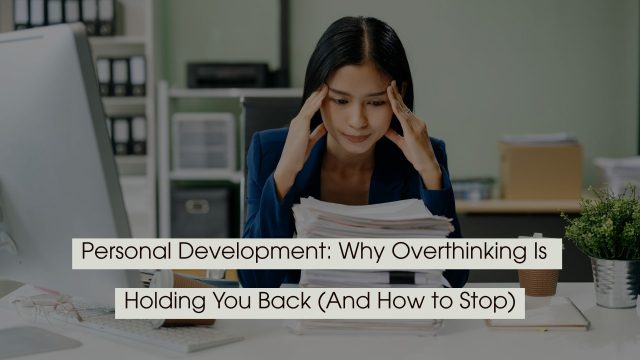
What Is Overthinking?
Overthinking is the habit of dwelling excessively on thoughts, decisions, or problems without moving toward action. It usually shows up in two forms:
- Rumination – Replaying past events and mistakes.
- Worrying – Obsessing over future uncertainties.
According to research from the American Psychological Association, chronic worry increases stress and can negatively impact mental and physical health.
Overthinking feels productive, but it rarely is.
Why Overthinking Is Holding You Back
1. It Paralyzes Decision-Making
Overthinking leads to analysis paralysis. You wait for the perfect option, the perfect timing, the perfect plan.
Perfectionism disguised as preparation keeps you stuck.
2. It Increases Stress Hormones
When you constantly replay problems, your brain activates the stress response. Research on stress and cognition suggests elevated cortisol levels impair clear thinking and decision-making.
The more you overthink, the harder it becomes to think clearly.
3. It Damages Confidence
Repeatedly questioning your choices trains your brain to doubt itself. Over time, this weakens self-trust — a core pillar of personal development.
Confidence grows through action, not over-analysis.
4. It Kills Momentum
Success compounds through small, consistent actions. Overthinking interrupts momentum by replacing movement with mental loops.
While you think, others act.
5. It Magnifies Fear
Your brain is wired for threat detection. When you overthink, you amplify potential risks while minimizing your capability to handle them.
This is known as catastrophizing, assuming the worst-case scenario will happen.
The Psychology Behind Overthinking
Overthinking often stems from:
- Fear of failure
- Fear of judgment
- Desire for control
- Low tolerance for uncertainty
- Perfectionism
In her research on mindset, Carol Dweck highlights how a fixed mindset increases fear of failure, which can fuel overthinking.
If you believe mistakes define you, you’ll try to think your way out of making them.
The Science: Why Action Reduces Anxiety
Studies show that taking action reduces anxiety because it restores a sense of control. Even small steps interrupt rumination cycles.
Your brain rewards progress with dopamine, reinforcing forward movement.
Action creates clarity.
Clarity reduces anxiety.
Reduced anxiety weakens overthinking.
How to Stop Overthinking (Practical Strategies)
1. Use the 5-Minute Decision Rule
If a decision won’t matter in five years, give yourself five minutes to decide.
Small decisions don’t deserve big mental energy.
2. Set a “Worry Window”
Schedule 10–15 minutes daily to write down worries. Outside that window, postpone them.
This trains your brain that worry has boundaries.
3. Replace “What If” With “Even If”
Instead of:
- “What if I fail?”
Say:
- “Even if I fail, I will learn.”
This shifts focus from fear to resilience.
4. Take Imperfect Action
Perfection is a delay tactic. Progress requires imperfection.
Send the email.
Launch the draft.
Start before you feel ready.
5. Challenge Cognitive Distortions
Ask yourself:
- Is this thought based on fact or assumption?
- Am I exaggerating the risk?
- What would I tell a friend in this situation?
6. Limit Information Intake
Too many opinions increase mental noise. Overconsumption fuels overthinking.
Set limits on research time.
7. Practice Mindfulness
Mindfulness strengthens your ability to observe thoughts without engaging them. Research from institutions like Harvard University has shown mindfulness practices reduce rumination and stress.
You are not your thoughts, you are the observer of them.
8. Build Self-Trust Through Micro-Commitments
Keep small promises to yourself daily:
- Wake up when you say you will.
- Finish small tasks.
- Follow through on commitments.
Self-trust weakens overthinking.
The Long-Term Impact of Stopping Overthinking
When you reduce overthinking:
- Decision-making becomes faster.
- Confidence increases.
- Stress decreases.
- Productivity improves.
- Opportunities multiply.
Personal development accelerates when action replaces hesitation.
Signs You’re Recovering From Overthinking
- You make decisions faster.
- You accept uncertainty.
- You focus on solutions.
- You act despite fear.
- You let go of perfection.
Progress isn’t the absence of fear, it’s movement despite it.
Sources & Further Reading
- American Psychological Association – Research on stress and rumination
- Carol Dweck – Mindset research
- Harvard University – Studies on mindfulness and stress reduction
- Nolen-Hoeksema, S. (2000). The role of rumination in depressive disorders
- Kabat-Zinn, J. (1994). Wherever You Go, There You Are
- Leahy, R. (2005). The Worry Cure
About the Author
David A. Caren is the creator of Emotional Optimization™ – helping high-performing professionals rewire emotional patterns for clarity, calm, and success.
Book a Free Consultation
Is overthinking a mental illness?
Overthinking itself is not a mental illness, but chronic rumination can be linked to anxiety and depression. If it significantly affects your life, professional support may help.
Why do intelligent people overthink?
High cognitive ability can lead to more mental simulations of possible outcomes. Intelligence doesn’t prevent anxiety, it can sometimes amplify it.
Can overthinking be cured permanently?
It may not disappear completely, but it can be managed effectively with consistent practice and mindset shifts.
How long does it take to stop overthinking?
Change depends on consistency. Many people notice improvement within weeks of applying structured techniques.
Does journaling help with overthinking?
Yes. Writing thoughts down externalizes them, reducing mental repetition.

What Successful People Do Differently Every Day (Daily Habits That Drive Success)
Successful people achieve more by focusing on consistent daily habits rather than relying on motivation. Through discipline, planning, and continuous…

How to Stop Procrastination and Take Action Immediately (Proven Strategies That Work)
Procrastination is driven by avoidance and fear, not laziness. By breaking tasks into small steps, taking immediate action, and removing…

What Is Self-Discipline and Why It Matters: The Foundation of Success and Personal Growth
Self-discipline is the ability to stay committed to your goals, even when motivation fades. By developing consistent habits, strengthening self-control,…

How to Transform Your Life One Day at a Time: Small Daily Changes That Lead to Extraordinary Results
Transform Your Life One Day at a Time: Transforming your life doesn’t happen overnight, it happens one day at a…

How to Develop Unbreakable Self-Discipline: The Ultimate Guide to Building Mental Strength and Consistency
Developing unbreakable self-discipline isn’t about relying on endless motivation or willpower. It’s about building consistent habits, keeping promises to yourself,…
How to Strengthen Your Willpower Every Day: Practical Strategies for Better Self-Control
Strengthening your willpower starts with small, intentional decisions. By reducing distractions, practicing delayed gratification, building supportive routines, and keeping promises…