A smiling young man stands outdoors holding folders and a notebook, representing self-confidence, personal growth, and self-awareness, with the text “How to Build Confidence Through Self-Awareness: The Foundation of Real Self-Belief” displayed across the image.

Many people chase confidence by focusing on external things:

Better appearance.
More success.
Validation from others.

But real confidence does not start outside of you.

It starts with self-awareness.

Self-awareness is the ability to understand:

  • Your thoughts
  • Your emotions
  • Your strengths
  • Your weaknesses
  • Your patterns

Without self-awareness, confidence often becomes fragile, dependent on outside approval.

With self-awareness, confidence becomes grounded.

Psychologist Daniel Goleman identifies self-awareness as the first core component of emotional intelligence.

In this article, you’ll learn how self-awareness can become the true foundation of lasting confidence.


Increase your self-awareness with one simple fix | Tasha Eurich | TEDxMileHigh
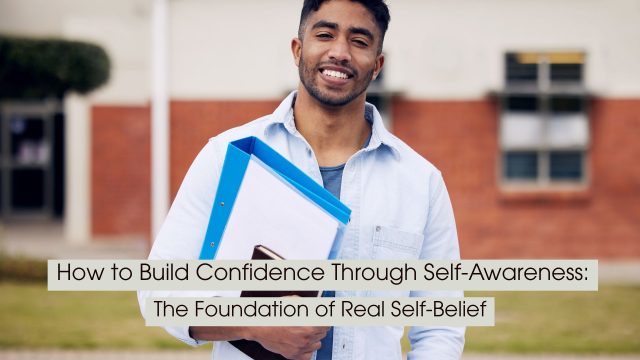
A smiling young man stands outdoors holding folders and a notebook, representing self-confidence, personal growth, and self-awareness, with the text “How to Build Confidence Through Self-Awareness: The Foundation of Real Self-Belief” displayed across the image.

What Is Self-Awareness?

Self-awareness is the ability to clearly understand yourself.

This includes:

  • How you think
  • How you feel
  • How you behave
  • What triggers you
  • What drives you

It means seeing yourself honestly, without denial or distortion.

Why Self-Awareness Builds Confidence

Confidence is not pretending to be perfect.

Confidence is trusting yourself.

And trust grows when you know yourself.

Self-awareness builds confidence by helping you:

  • Recognize strengths
  • Accept weaknesses
  • Improve intentionally
  • Make aligned decisions
  • Reduce insecurity

The Psychology Behind Confidence and Self-Awareness

Psychologist Albert Bandura explains that confidence is deeply connected to self-efficacy, your belief in your ability to handle challenges.

Self-awareness improves self-efficacy because it helps you accurately assess:

  • What you can do
  • What you need to improve
  • How to grow

This creates realistic, resilient confidence.

How to Build Confidence Through Self-Awareness

1. Identify Your Strengths

Confidence grows when you recognize your capabilities.

Ask yourself:

  • What do I do well?
  • What strengths do others notice in me?
  • Where have I succeeded before?

Knowing your strengths strengthens self-trust.

2. Acknowledge Your Weaknesses Without Shame

Weaknesses do not destroy confidence.

Avoiding them does.

Self-aware people can say: “I need growth here, and that’s okay.”

Honest awareness builds real confidence.

3. Understand Your Emotional Triggers

Notice what causes:

  • Self-doubt
  • Fear
  • Overthinking
  • Defensiveness

Awareness of triggers helps you manage them instead of being controlled by them.

4. Observe Your Self-Talk

Your internal dialogue shapes confidence.

Replace:

  • “I’m not enough”

With:

  • “I’m learning.”

Self-awareness helps you catch harmful thought patterns.

5. Align With Your Values

Confidence strengthens when you live according to your values, not external expectations.

Ask:

  • What truly matters to me?
  • Am I living in alignment with that?

Alignment creates inner stability.

6. Reflect Regularly

Journaling, self-reflection, or quiet review can strengthen self-awareness.

Ask:

  • What did I do well today?
  • Where did I feel insecure?
  • What can I improve?

Reflection creates growth.

Self-Awareness vs Ego

Ego:

  • Defensive
  • Fragile
  • External validation-driven

Self-Awareness:

  • Honest
  • Grounded
  • Growth-oriented

True confidence is built on awareness, not ego.

Common Mistakes to Avoid

Ignoring Weaknesses

Avoidance weakens growth.

Seeking Constant Validation

External approval is unstable.

Comparing Yourself to Others

Comparison distorts self-perception.

Confusing Confidence With Perfection

Confidence is trust, not flawlessness.

Daily Habits That Strengthen Self-Awareness

Journaling

Track thoughts and patterns.

Mindfulness

Notice emotions without judgment.

Honest Feedback

Ask trusted people for perspective.

Reflection

Review decisions and behavior regularly.

Why Self-Awareness Creates Lasting Confidence

When you know yourself, you can:

  • Trust yourself more
  • Make better decisions
  • Handle criticism better
  • Improve intentionally
  • Stay emotionally grounded

Confidence becomes less about proving, and more about trusting.

Conclusion

Building confidence through self-awareness is one of the most powerful forms of personal development.

When you understand yourself deeply, you no longer need to build confidence on fragile external factors.

You build it on truth.

Self-awareness helps you recognize your strengths, improve your weaknesses, and trust yourself more fully.

Because confidence is not about becoming someone else.

It’s about understanding yourself enough to believe in who you already are—and who you are becoming.

Sources and Further Reading

  • Daniel Goleman – Emotional intelligence
  • Albert Bandura – Self-efficacy theory
  • Goleman, D. (1995). Emotional Intelligence
  • Bandura, A. – Self-Efficacy Research

About the Author

David A. Caren is the creator of Emotional Optimization™ – helping high-performing professionals rewire emotional patterns for clarity, calm, and success.

How does self-awareness build confidence?

It strengthens self-trust by helping you understand your strengths, weaknesses, and emotional patterns.

Can confidence exist without self-awareness?

It may exist temporarily, but it is often fragile.

What is the first step to self-awareness?

Honest reflection.

Is self-awareness part of emotional intelligence?

Yes. It is a core foundation.

Can self-awareness reduce insecurity?

Yes. It helps you understand and manage self-doubt.
Tap Into Your Emotional Superpowers:

Reclaim Your Mental & Emotional Resources To Do More, Be More, & LIVE More Fully

The Desire: Reclaim Your Joy, Purpose & Inner Peace with Emotional Optimization

In the hustle and bustle of today's world, do you feel like your emotions are on a rollercoaster with no brakes? Caught in a relentless storm of stress, anxiety, and uncertainty; it's all too easy to feel lost, disconnected from your true self, and powerless in steering the course of your own life.

In the bustling rhythm of modern life, where achievements are often measured in milestones and material success, it's easy to overlook the silent whispers of our inner selves. Like a ship navigating a vast, unpredictable ocean, we often find ourselves lost in the storms of overwhelm, stress, anxiety, and unfulfilled desires. This is the journey of every single soul searching for a ray of light in the darkness - a calm, peaceful, fulfilled life with emotional serenity, inner confidence and strength. Emotional Optimization is a way to navigate your inner world, to release the energy you've been wasting on old triggers and buttons, and to reclaim your mental and emotional resources so you can do more in life, create a bigger impact on the world, and live life more fully on your terms as you continue your journey to emotional mastery.

The Challenge: Emotional Triggers & Unresolved Traumas

Pause for a moment and imagine the heavy toll those unchecked emotions are having on your life. Relationships strained to their breaking points, opportunities slipping like sand through your fingers, and a constant, gnawing sense of not living up to your full potential. This isn't just about facing daily hurdles; it's about the very essence of your happiness and fulfillment being eroded away, day after draining day, WASTING your precious life REACTING to unresolved emotional triggers and old traumas.

Imagine walking through a labyrinth, where each turn represents a challenge, a moment of doubt, or a trigger of unresolved emotion. This is the odyssey of the modern high achiever. Despite the outward success, there always seems to be an underlying struggle - a battle with emotions that feel like uncharted waters. In an age where the pursuit of happiness often leads to more questions than answers, many find themselves adrift, caught in a cycle of emotional highs and lows, constantly looking for a safe place where they can achieve balance, peace, and genuine fulfillment.


The Solution: Emotional Optimization

This is where Emotional Optimization comes in. David's highly personalized coaching program is designed to equip you with the tools and strategies you need to understand, manage, and transform your emotions. By mastering emotional intelligence, you unlock the door to improved communication, stronger relationships, and heightened self-awareness. It's time to reclaim all the mental and emotional resources you've been wasting in the background on the subconscious emotional triggers from past traumas and unresolved emotions. You deserve to live FREE from the emotional baggage and burdens of your past. It's time to step into peace, confidence, and clarity, so you can be more present, have deeper relationships, and feel more fulfilled in life.

Benefits:

  • Enhanced Emotional Intelligence: Elevate your ability to understand, process, use, & manage your emotions in positive ways to relieve stress, communicate effectively, empathize with others, overcome challenges, & make choices that align with your deepest values & aspirations.
  • Improved Relationships: Transform your personal and professional relationships through self-reflection, better communication, empathy, and emotional understanding.
  • Increased Emotional Resilience: Build a robust emotional foundation that enables you to navigate life's ups & downs with grace & poise, turning potential setbacks into opportunities for growth. Arm yourself with resilience that turns life's fiercest storms into moments of strength & empowerment.
  • Personal and Professional Growth: Unlock your full potential by harnessing the power of emotional optimization to achieve your goals, boost productivity, and amplify a sense of accomplishment, satisfaction, and fulfillment in all areas of life.

About The Author

David's Team

Let's Connect!

Leave a comment

Your email address will not be published. Required fields are marked

{"email":"Email address invalid","url":"Website address invalid","required":"Required field missing"}
A stressed man sitting at a desk holding his head beside a laptop, with text overlay reading “Emotional Optimization: How to Recover Faster After a Bad Day.”

Emotional Optimization: How to Recover Faster After a Bad Day

Bad days happen but staying stuck in them doesn’t have to. Emotional optimization is the skill of helping your mind and body recover faster after stress, disappointment, overwhelm, or emotional exhaustion. In this guide, you’ll learn practical strategies to reset your nervous system, process emotions in a healthy way, and bounce back with clarity, calm, and self-respect, without pretending everything is fine.

Read More
A woman sitting with her knees pulled close, looking sad and thoughtful, with text overlay reading “Emotional Optimization: How to Optimize Emotions During Life Transitions.”

Emotional Optimization: How to Optimize Emotions During Life Transitions

Emotional optimization helps you stay grounded, resilient, and emotionally clear during major life transitions. Whether you’re changing careers, moving to a new place, ending a relationship, becoming a parent, or entering a new season of life, transitions can trigger anxiety, grief, uncertainty, and emotional overload. This guide explains why change feels so intense and how emotional optimization tools can help you manage stress, rebuild self-trust, and move forward with more peace and confidence.

Read More
A woman standing with her arms open and eyes closed, appearing calm and confident, with text overlay reading “Emotional Optimization for Social Anxiety: How to Feel Calm, Confident, and In Control.”

Emotional Optimization for Social Anxiety: How to Feel Calm, Confident, and In Control

Emotional optimization for social anxiety helps you manage fear of judgment, overthinking, and nervous system overwhelm in social situations. Instead of avoiding people or forcing yourself to “be confident,” emotional optimization teaches you how to regulate anxiety in your body, shift anxious thought patterns, and build real self-trust through gradual exposure. This guide explains why social anxiety happens and how to feel more comfortable being seen, speaking up, and connecting with others.

Read More
A professional practicing mindfulness by reading a book, representing personal growth, self-awareness, and stress management for busy professionals.

Personal Growth Through Mindfulness: A Practical Guide for Busy Professionals

In today’s fast-paced world, personal growth often takes a back seat to deadlines, responsibilities, and constant digital noise. Mindfulness offers a powerful yet simple way to slow down, reconnect with yourself, and grow with intention—even in the busiest seasons of life. By practicing awareness, presence, and emotional regulation, busy professionals can reduce stress, improve focus, and create lasting personal growth without adding more to their already full schedules.

Read More
A woman sitting at a desk holds her temples while looking stressed, illustrating emotional intelligence and how to regulate emotions in stressful situations.

Emotional Intelligence: How to Regulate Your Emotions in Stressful Situations

In moments of stress, our emotions often take control before logic has a chance to step in. Emotional intelligence helps bridge that gap by teaching you how to recognize, understand, and regulate your emotional responses in real time. By developing greater self-awareness and emotional control, you can respond to pressure with clarity instead of panic, make better decisions, and maintain balance even in high-stress situations. This guide explores practical strategies to help you manage emotional overwhelm and build resilience in both your personal and professional life.

Read More
A woman standing indoors looking upward thoughtfully, representing personal growth through setbacks and turning challenges into powerful opportunities for self-improvement.

Personal Growth Through Setbacks: How to Turn Challenges Into Powerful Growth Opportunities

Setbacks are an inevitable part of life, but they don’t have to define your future. In fact, some of the most powerful personal growth happens in moments of challenge, failure, and uncertainty. When viewed through the right lens, obstacles become opportunities to build resilience, gain clarity, and develop emotional strength. This article explores how embracing setbacks can help you grow stronger, wiser, and more confident, turning life’s challenges into meaningful stepping stones toward lasting personal growth.

Read More