Table of Contents
- What Is Negative Self-Talk? – When Is It a Problem? | Child Mind Institute
- What Is Negative Self-Talk?
- Why Negative Self-Talk Damages Personal Development
- How to Stop Negative Self-Talk: 7 Personal Development Strategies
- 1. Catch the Thought Immediately
- 2. Challenge the Thought
- 3. Replace It With a Healthier Thought
- 4. Practice Self-Compassion
- 5. Use Daily Affirmations
- 6. Surround Yourself With Positive Influences
- 7. Celebrate Small Wins
- Building Inner Confidence Through Personal Development
- The Truth: You Are Not Your Thoughts
- Sources & Further Reading
- 1. Mayo Clinic – Positive Thinking and Self-Talk
- 2. American Psychological Association – Building Confidence and Managing Self-Doubt
- 3. Cognitive Behavioral Therapy (CBT) Basics – Anxiety & Negative Self-Talk
- 4. Kristin Neff, PhD – Self-Compassion Research & Practices
- 5. Harvard Health Publishing – How Negative Thinking Affects Mental Health
- 6. National Institute of Mental Health – Stress & Emotional Wellness
- 7. The Science of Mindset – Carol Dweck (Growth Mindset Research)
- About the Author
- Book a Free Consultation
Negative self-talk is one of the biggest silent blockers in personal development. It quietly undermines your confidence, limits your success, and keeps you stuck in patterns that do not reflect your true potential. Learning how to stop negative self-talk and replace it with empowering thoughts is one of the most transformative steps you can take in your personal development journey.
In this article, you’ll learn what negative self-talk is, why it happens, how it impacts your confidence, and the actionable strategies you can apply daily to build inner confidence and strengthen your personal development.
What Is Negative Self-Talk? – When Is It a Problem? | Child Mind Institute
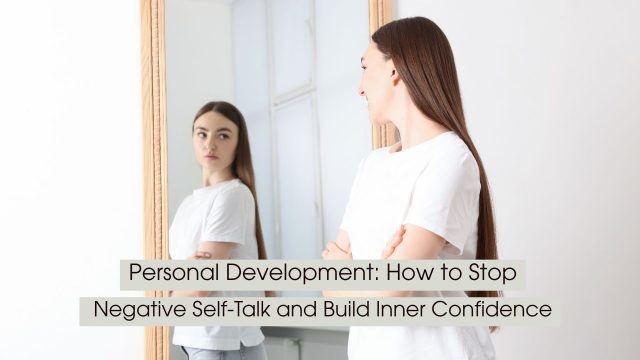
What Is Negative Self-Talk?
Negative self-talk is the internal dialogue that criticizes, doubts, or discourages you.
It sounds like:
- “I’m not good enough.”
- “I always mess things up.”
- “Other people are better than me.”
- “I’ll never succeed.”
This inner voice often comes from past conditioning, childhood experiences, fear, and unrealistic expectations. Over time, it becomes an automatic habit, but the good news is that it can be rewired through intentional personal development practices.
Why Negative Self-Talk Damages Personal Development
Negative self-talk creates:
1. Low Self-Esteem
When you constantly criticize yourself, your self-worth declines.
2. Fear of Failure
You become afraid to try new things because you expect to fail.
3. Anxiety & Overthinking
Your mind gets stuck in “what if” scenarios that drain your energy.
4. Self-Sabotage
You hold yourself back from opportunities that could help you grow.
5. A Fixed Mindset
You start believing your abilities cannot improve which limits personal development.
Stopping negative self-talk is not just about feeling better; it’s about unlocking your full potential.
How to Stop Negative Self-Talk: 7 Personal Development Strategies
These strategies help you rewire your mindset and build lasting inner confidence.
1. Catch the Thought Immediately
Awareness is the first step. Notice when you say things like:
- “This is too hard.”
- “I can’t do this.”
Simply recognizing the thought weakens its power.
2. Challenge the Thought
Ask yourself:
- Is this true?
- What evidence proves this?
- Would I say this to a friend?
Most negative thoughts are exaggerated, irrational, or completely untrue.
3. Replace It With a Healthier Thought
Swap negativity with grounded, supportive statements such as:
- “I’m still learning.”
- “I’ve succeeded before; I can do it again.”
- “I am capable and improving every day.”
This is a core part of cognitive personal development.
4. Practice Self-Compassion
Talk to yourself with kindness, empathy, and understanding.
Self-compassion boosts confidence and reduces anxiety more effectively than harsh self-criticism.
Try saying:
“It’s okay to make mistakes. I’m doing my best, and I’m growing.“
5. Use Daily Affirmations
Affirmations help rewire the mind by reinforcing empowering beliefs.
Examples:
- “I trust myself.”
- “I am worthy and capable.”
- “I choose confidence today.”
Repeat them every morning for long-term personal development.
6. Surround Yourself With Positive Influences
Your environment matters.
Limit time with people who drain your energy or reinforce negativity.
Spend more time with those who encourage growth and confidence.
7. Celebrate Small Wins
Confidence grows through acknowledgment.
Even small achievements deserve recognition.
Write down 3 wins every day, no matter how small, to train your mind to notice progress instead of flaws.
Building Inner Confidence Through Personal Development
Inner confidence is not loud, flashy, or ego-driven.
It comes from:
- Knowing your strengths
- Accepting your imperfections
- Trusting your ability to grow
- Believing you deserve good things
- Speaking to yourself with compassion
When you practice personal development consistently, your confidence becomes unshakable, not because everything is perfect, but because you trust yourself to handle anything.
The Truth: You Are Not Your Thoughts
Negative self-talk does not define you.
It is simply an old mental pattern that can be unlearned.
With awareness, compassion, and daily practice, you can rewrite your inner dialogue and build a confident, grounded, empowered version of yourself.
Your mind is powerful and you have the ability to shape it.
Transforming negative self-talk is one of the most life-changing personal development skills you can learn. By observing your thoughts, challenging your inner critic, and replacing negative patterns with supportive ones, you create a mindset that supports confidence, peace, and success.
Personal development begins the moment you choose to speak to yourself with more love than judgment.
You deserve that.
Sources & Further Reading
1. Mayo Clinic – Positive Thinking and Self-Talk
A clear and research-backed explanation of how self-talk affects mental and emotional well-being.
https://www.mayoclinic.org/healthy-lifestyle/stress-management/in-depth/positive-thinking/art-20043950
2. American Psychological Association – Building Confidence and Managing Self-Doubt
An evidence-based resource on self-esteem, confidence, and cognitive reframing.
https://www.apa.org/topics/self-esteem
3. Cognitive Behavioral Therapy (CBT) Basics – Anxiety & Negative Self-Talk
An overview of how CBT helps reframe distorted thinking patterns.
https://www.psychologytoday.com/us/basics/cognitive-behavioral-therapy
4. Kristin Neff, PhD – Self-Compassion Research & Practices
One of the leading researchers on self-compassion and its impact on confidence and resilience.
https://self-compassion.org/
5. Harvard Health Publishing – How Negative Thinking Affects Mental Health
Breaks down the psychological and physiological impact of chronic negative self-talk.
https://www.health.harvard.edu/mind-and-mood/are-you-a-worrier
6. National Institute of Mental Health – Stress & Emotional Wellness
Helpful insights on managing stress, anxiety, and emotional triggers.
https://www.nimh.nih.gov/health/topics/stress
7. The Science of Mindset – Carol Dweck (Growth Mindset Research)
Foundational research on how shifting your mindset affects confidence, behavior, and personal development.
https://www.mindsetworks.com/science/
About the Author
David A. Caren is the creator of Emotional Optimization™ – helping high-performing professionals rewire emotional patterns for clarity, calm, and success.
Book a Free Consultation
What is negative self-talk, and why does it happen?
Negative self-talk is the internal dialogue that criticizes or doubts your abilities. It often develops from past experiences, unrealistic expectations, fear of failure, or learned behavior. In personal development, understanding where negative thoughts come from is the first step to replacing them with empowering ones.
How does negative self-talk affect personal development?
Negative self-talk limits your potential by lowering your self-esteem, increasing anxiety, and stopping you from trying new things. It weakens confidence and creates self-sabotaging behaviors. Transforming your inner dialogue is essential in any personal development journey because it opens the door to growth and success.
Can I really stop negative self-talk completely?
You may not eliminate negative thoughts entirely — that’s part of being human — but you can learn to manage and reframe them. With consistent personal development practices like self-awareness, mindfulness, and cognitive reframing, negative self-talk becomes quieter, weaker, and less frequent.
What is the fastest way to build inner confidence?
The fastest way to build inner confidence is through small, consistent wins. Celebrate progress, practice self-compassion, and take action even when you feel uncertain. Confidence grows through repetition and positive reinforcement, which are core principles of personal development.
Are affirmations effective for reducing negative self-talk?
Yes. When used consistently, affirmations help rewire the brain by replacing disempowering thoughts with positive ones. They support long-term personal development by strengthening new mental habits and increasing self-belief.
Emotional Optimization: How to Recover Faster After a Bad Day
Bad days happen—but staying stuck in them doesn’t have to. Emotional optimization is the skill of helping your mind and…


Emotional Optimization: How to Optimize Emotions When Starting Something New
Emotional optimization helps you stay calm, confident, and emotionally grounded when starting something new. Whether you’re beginning a new job,…
Emotional Optimization: How to Recover Faster After a Bad Day
Bad days happen but staying stuck in them doesn’t have to. Emotional optimization is the skill of helping your mind…

Emotional Optimization: How to Optimize Emotions During Life Transitions
Emotional optimization helps you stay grounded, resilient, and emotionally clear during major life transitions. Whether you’re changing careers, moving to…
Emotional Optimization for Social Anxiety: How to Feel Calm, Confident, and In Control
Emotional optimization for social anxiety helps you manage fear of judgment, overthinking, and nervous system overwhelm in social situations. Instead…
Personal Growth Through Mindfulness: A Practical Guide for Busy Professionals
In today’s fast-paced world, personal growth often takes a back seat to deadlines, responsibilities, and constant digital noise. Mindfulness offers…