August 26, 2026

Personal Development: Why Overthinking Is Holding You Back (And How to Stop)

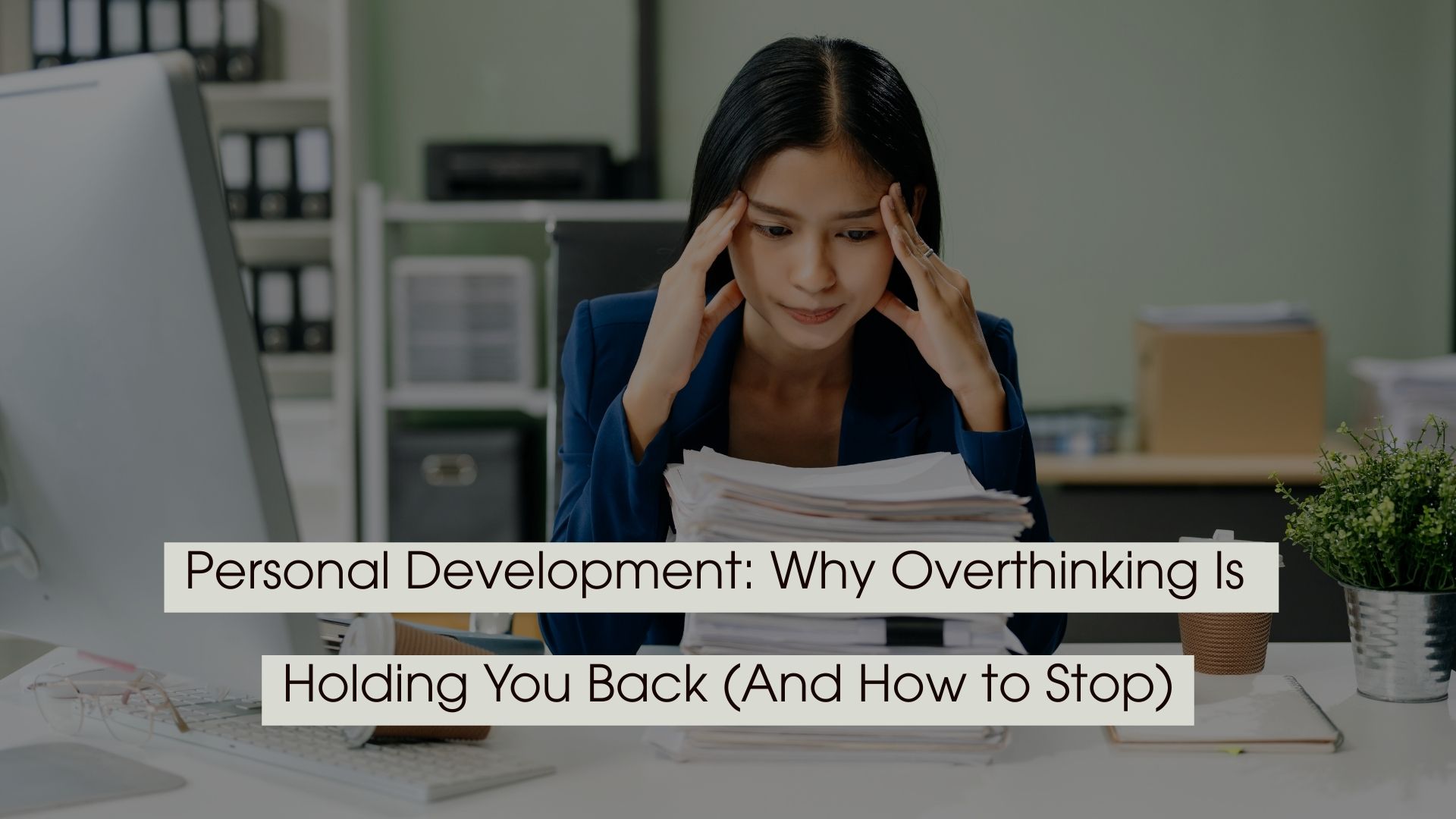
Woman in an office setting looking stressed while holding her temples and staring at a stack of papers, with the text “Personal Development: Why Overthinking Is Holding You Back (And How to Stop)” displayed across the image.

Personal development is often about taking action, starting the project, having the conversation, launching the idea. But overthinking quietly stops progress before it even begins.

You replay conversations.
You imagine worst-case scenarios.
You analyze every possible outcome.

And while you’re thinking… life moves on.

If you’ve ever felt stuck in your own head, this guide will show you why overthinking is holding you back, and exactly how to stop.


What is Overthinking and How to prevent it
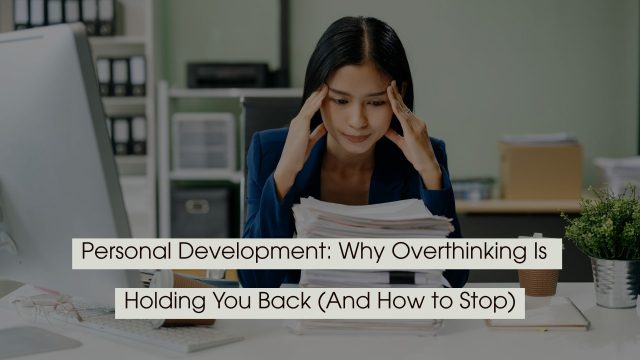
Woman in an office setting looking stressed while holding her temples and staring at a stack of papers, with the text “Personal Development: Why Overthinking Is Holding You Back (And How to Stop)” displayed across the image.

What Is Overthinking?

Overthinking is the habit of dwelling excessively on thoughts, decisions, or problems without moving toward action. It usually shows up in two forms:

  • Rumination – Replaying past events and mistakes.
  • Worrying – Obsessing over future uncertainties.

According to research from the American Psychological Association, chronic worry increases stress and can negatively impact mental and physical health.

Overthinking feels productive, but it rarely is.

Why Overthinking Is Holding You Back

1. It Paralyzes Decision-Making

Overthinking leads to analysis paralysis. You wait for the perfect option, the perfect timing, the perfect plan.

Perfectionism disguised as preparation keeps you stuck.

2. It Increases Stress Hormones

When you constantly replay problems, your brain activates the stress response. Research on stress and cognition suggests elevated cortisol levels impair clear thinking and decision-making.

The more you overthink, the harder it becomes to think clearly.

3. It Damages Confidence

Repeatedly questioning your choices trains your brain to doubt itself. Over time, this weakens self-trust — a core pillar of personal development.

Confidence grows through action, not over-analysis.

4. It Kills Momentum

Success compounds through small, consistent actions. Overthinking interrupts momentum by replacing movement with mental loops.

While you think, others act.

5. It Magnifies Fear

Your brain is wired for threat detection. When you overthink, you amplify potential risks while minimizing your capability to handle them.

This is known as catastrophizing, assuming the worst-case scenario will happen.

The Psychology Behind Overthinking

Overthinking often stems from:

  • Fear of failure
  • Fear of judgment
  • Desire for control
  • Low tolerance for uncertainty
  • Perfectionism

In her research on mindset, Carol Dweck highlights how a fixed mindset increases fear of failure, which can fuel overthinking.

If you believe mistakes define you, you’ll try to think your way out of making them.

The Science: Why Action Reduces Anxiety

Studies show that taking action reduces anxiety because it restores a sense of control. Even small steps interrupt rumination cycles.

Your brain rewards progress with dopamine, reinforcing forward movement.

Action creates clarity.
Clarity reduces anxiety.
Reduced anxiety weakens overthinking.

How to Stop Overthinking (Practical Strategies)

1. Use the 5-Minute Decision Rule

If a decision won’t matter in five years, give yourself five minutes to decide.

Small decisions don’t deserve big mental energy.

2. Set a “Worry Window”

Schedule 10–15 minutes daily to write down worries. Outside that window, postpone them.

This trains your brain that worry has boundaries.

3. Replace “What If” With “Even If”

Instead of:

  • “What if I fail?”

Say:

  • “Even if I fail, I will learn.”

This shifts focus from fear to resilience.

4. Take Imperfect Action

Perfection is a delay tactic. Progress requires imperfection.

Send the email.
Launch the draft.
Start before you feel ready.

5. Challenge Cognitive Distortions

Ask yourself:

  • Is this thought based on fact or assumption?
  • Am I exaggerating the risk?
  • What would I tell a friend in this situation?

6. Limit Information Intake

Too many opinions increase mental noise. Overconsumption fuels overthinking.

Set limits on research time.

7. Practice Mindfulness

Mindfulness strengthens your ability to observe thoughts without engaging them. Research from institutions like Harvard University has shown mindfulness practices reduce rumination and stress.

You are not your thoughts, you are the observer of them.

8. Build Self-Trust Through Micro-Commitments

Keep small promises to yourself daily:

  • Wake up when you say you will.
  • Finish small tasks.
  • Follow through on commitments.

Self-trust weakens overthinking.

The Long-Term Impact of Stopping Overthinking

When you reduce overthinking:

  • Decision-making becomes faster.
  • Confidence increases.
  • Stress decreases.
  • Productivity improves.
  • Opportunities multiply.

Personal development accelerates when action replaces hesitation.

Signs You’re Recovering From Overthinking

  • You make decisions faster.
  • You accept uncertainty.
  • You focus on solutions.
  • You act despite fear.
  • You let go of perfection.

Progress isn’t the absence of fear, it’s movement despite it.

Sources & Further Reading

  • American Psychological Association – Research on stress and rumination
  • Carol Dweck – Mindset research
  • Harvard University – Studies on mindfulness and stress reduction
  • Nolen-Hoeksema, S. (2000). The role of rumination in depressive disorders
  • Kabat-Zinn, J. (1994). Wherever You Go, There You Are
  • Leahy, R. (2005). The Worry Cure

About the Author

David A. Caren is the creator of Emotional Optimization – helping high-performing professionals rewire emotional patterns for clarity, calm, and success.

Book a Free Consultation

Is overthinking a mental illness?

Overthinking itself is not a mental illness, but chronic rumination can be linked to anxiety and depression. If it significantly affects your life, professional support may help.

Why do intelligent people overthink?

High cognitive ability can lead to more mental simulations of possible outcomes. Intelligence doesn’t prevent anxiety, it can sometimes amplify it.

Can overthinking be cured permanently?

It may not disappear completely, but it can be managed effectively with consistent practice and mindset shifts.

How long does it take to stop overthinking?

Change depends on consistency. Many people notice improvement within weeks of applying structured techniques.

Does journaling help with overthinking?

Yes. Writing thoughts down externalizes them, reducing mental repetition.

Tap Into Your Emotional Superpowers:

Reclaim Your Mental & Emotional Resources To Do More, Be More, & LIVE More Fully

The Desire: Reclaim Your Joy, Purpose & Inner Peace with Emotional Optimization

In the hustle and bustle of today's world, do you feel like your emotions are on a rollercoaster with no brakes? Caught in a relentless storm of stress, anxiety, and uncertainty; it's all too easy to feel lost, disconnected from your true self, and powerless in steering the course of your own life.

In the bustling rhythm of modern life, where achievements are often measured in milestones and material success, it's easy to overlook the silent whispers of our inner selves. Like a ship navigating a vast, unpredictable ocean, we often find ourselves lost in the storms of overwhelm, stress, anxiety, and unfulfilled desires. This is the journey of every single soul searching for a ray of light in the darkness - a calm, peaceful, fulfilled life with emotional serenity, inner confidence and strength. Emotional Optimization is a way to navigate your inner world, to release the energy you've been wasting on old triggers and buttons, and to reclaim your mental and emotional resources so you can do more in life, create a bigger impact on the world, and live life more fully on your terms as you continue your journey to emotional mastery.

The Challenge: Emotional Triggers & Unresolved Traumas

Pause for a moment and imagine the heavy toll those unchecked emotions are having on your life. Relationships strained to their breaking points, opportunities slipping like sand through your fingers, and a constant, gnawing sense of not living up to your full potential. This isn't just about facing daily hurdles; it's about the very essence of your happiness and fulfillment being eroded away, day after draining day, WASTING your precious life REACTING to unresolved emotional triggers and old traumas.

Imagine walking through a labyrinth, where each turn represents a challenge, a moment of doubt, or a trigger of unresolved emotion. This is the odyssey of the modern high achiever. Despite the outward success, there always seems to be an underlying struggle - a battle with emotions that feel like uncharted waters. In an age where the pursuit of happiness often leads to more questions than answers, many find themselves adrift, caught in a cycle of emotional highs and lows, constantly looking for a safe place where they can achieve balance, peace, and genuine fulfillment.


The Solution: Emotional Optimization

This is where Emotional Optimization comes in. David's highly personalized coaching program is designed to equip you with the tools and strategies you need to understand, manage, and transform your emotions. By mastering emotional intelligence, you unlock the door to improved communication, stronger relationships, and heightened self-awareness. It's time to reclaim all the mental and emotional resources you've been wasting in the background on the subconscious emotional triggers from past traumas and unresolved emotions. You deserve to live FREE from the emotional baggage and burdens of your past. It's time to step into peace, confidence, and clarity, so you can be more present, have deeper relationships, and feel more fulfilled in life.

Benefits:

  • Enhanced Emotional Intelligence: Elevate your ability to understand, process, use, & manage your emotions in positive ways to relieve stress, communicate effectively, empathize with others, overcome challenges, & make choices that align with your deepest values & aspirations.
  • Improved Relationships: Transform your personal and professional relationships through self-reflection, better communication, empathy, and emotional understanding.
  • Increased Emotional Resilience: Build a robust emotional foundation that enables you to navigate life's ups & downs with grace & poise, turning potential setbacks into opportunities for growth. Arm yourself with resilience that turns life's fiercest storms into moments of strength & empowerment.
  • Personal and Professional Growth: Unlock your full potential by harnessing the power of emotional optimization to achieve your goals, boost productivity, and amplify a sense of accomplishment, satisfaction, and fulfillment in all areas of life.

About The Author

David's Team

Let's Connect!

Leave a comment

Your email address will not be published. Required fields are marked

{"email":"Email address invalid","url":"Website address invalid","required":"Required field missing"}
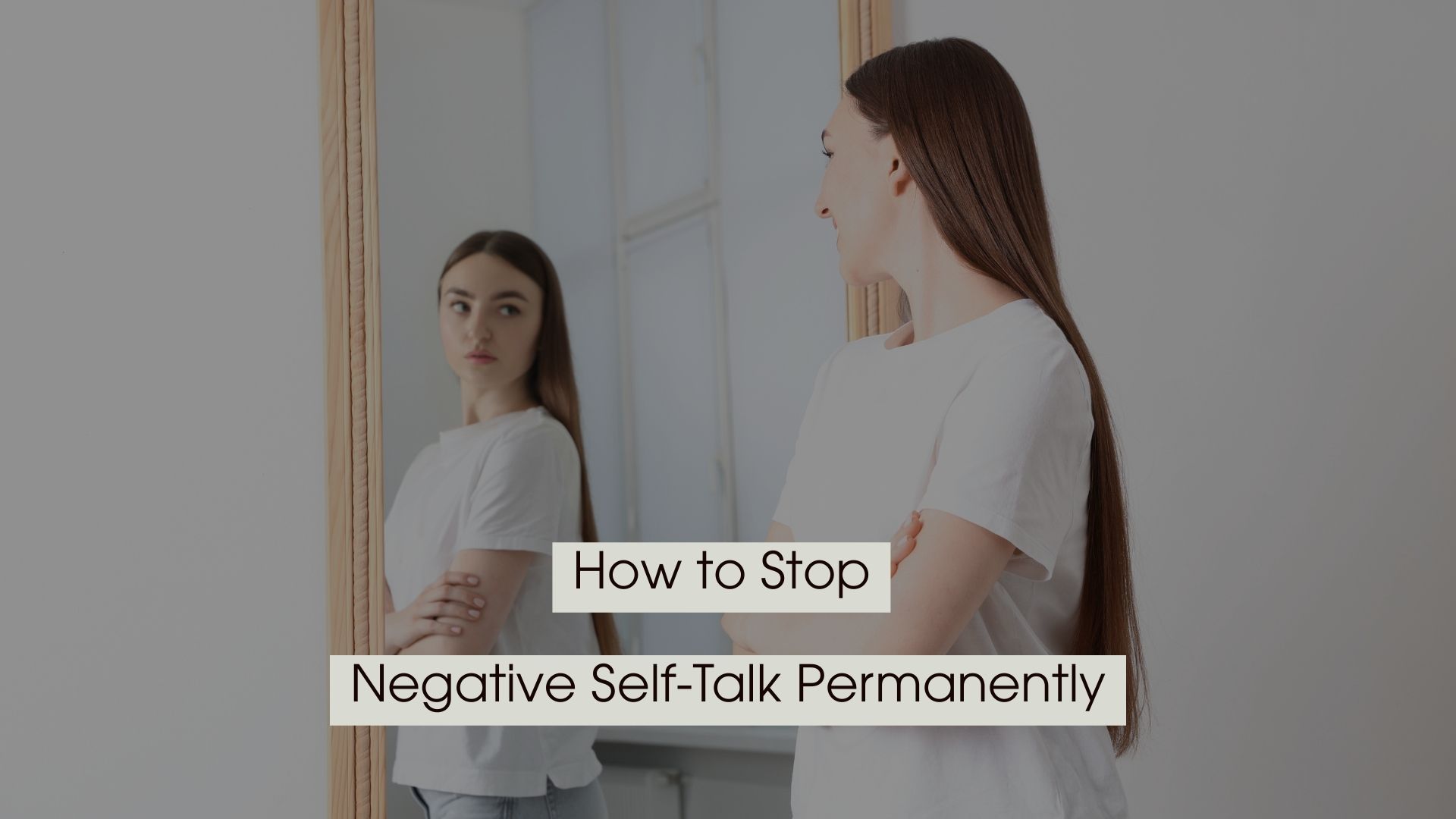
Young woman standing with arms crossed while looking at her reflection in a mirror, with the text “How to Stop Negative Self-Talk Permanently” displayed across the image.

How Stop Negative Self-Talk Permanently

Negative self-talk is not permanent, it is a learned pattern that can be rewired. Through awareness, cognitive restructuring, and self-compassion, you can transform your inner dialogue and strengthen your personal development journey. Change the way you speak to yourself, and you change the way you show up in the world.

Read More
Silhouette of a confident person standing with arms raised against a cloudy sky, symbolizing overcoming imposter syndrome, fear of failure, and reclaiming self-confidence.

Imposter Syndrome and the Fear of Failure: How to Break the Cycle and Reclaim Your Confidence

Imposter syndrome and the fear of failure often go hand in hand, quietly undermining confidence and holding people back from reaching their full potential. Even high achievers can feel like they don’t truly deserve their success, constantly worrying they’ll be “found out.” In this article, we explore how imposter syndrome develops, why fear of failure keeps it alive, and practical strategies to break the cycle—so you can build self-trust, embrace growth, and move forward with confidence.

Read More
Group of professionals standing side by side holding cards with question marks over their faces, symbolizing self-doubt and identity confusion, with text reading “Imposter Syndrome and Identity: Who You Think You Are vs. Who You Really Are.

Imposter Syndrome and Identity: Who You Think You Are vs. Who You Really Are

Imposter syndrome often creates a painful gap between who you believe you are and who you truly are beneath the doubt. It convinces capable, accomplished people that their success is accidental and that they’re only one mistake away from being “found out.” In this article, we explore how imposter syndrome shapes identity, why it distorts self-perception, and how reconnecting with your authentic self can help you reclaim confidence, clarity, and inner stability.

Read More
Man sitting on a couch with head in hands, appearing stressed and overwhelmed, representing imposter syndrome in men and the silent struggle behind success.

Imposter Syndrome in Men: The Silent Struggle Behind Success

Imposter syndrome in men often goes unnoticed, hidden behind confidence, achievement, and the pressure to appear strong. Many men silently battle self-doubt, fear of failure, and the belief that their success is undeserved—despite clear evidence of their competence. This article explores how imposter syndrome uniquely affects men, why it’s so difficult to talk about, and practical ways to break free from the cycle of self-sabotage and reclaim authentic confidence.

Read More
A woman standing indoors looking upward thoughtfully, representing personal growth through setbacks and turning challenges into powerful opportunities for self-improvement.

Personal Growth Through Setbacks: How to Turn Challenges Into Powerful Growth Opportunities

Setbacks are an inevitable part of life, but they don’t have to define your future. In fact, some of the most powerful personal growth happens in moments of challenge, failure, and uncertainty. When viewed through the right lens, obstacles become opportunities to build resilience, gain clarity, and develop emotional strength. This article explores how embracing setbacks can help you grow stronger, wiser, and more confident, turning life’s challenges into meaningful stepping stones toward lasting personal growth.

Read More
Woman embracing freedom and confidence, representing personal growth through letting go of fear and self-sabotaging thoughts.

Personal Growth Through Letting Go of Fear and Self-Sabotage

Personal growth often begins when we confront the fears and self-sabotaging patterns that quietly hold us back. Letting go of fear isn’t about eliminating doubt entirely—it’s about learning to move forward despite it. When you release limiting beliefs, perfectionism, and the need for control, you create space for clarity, confidence, and authentic progress. This article explores how letting go of fear and self-sabotage can unlock emotional freedom, improve decision-making, and help you step into the version of yourself you’re meant to become.

Read More